Every value kept.
Every gap marked.
Vault is an industrial data historian for battery storage and grid-connected generation. One Windows program on the panel PC already in the cabinet, collecting OPC UA and Modbus TCP, with no tag limit and one price per site.
Made by Blue Paw Software, a small UK software company. Vault 0.1 is in evaluation now.
When the link to the PLC drops, the record says so. Vault stores the outage, its cause and both edges, and never joins the line across it.
The plant's record, on one screen
Vault shows the site the way the people who run it think about it: equipment on the left, the trend in the middle, what happened on the right, and time along the bottom.
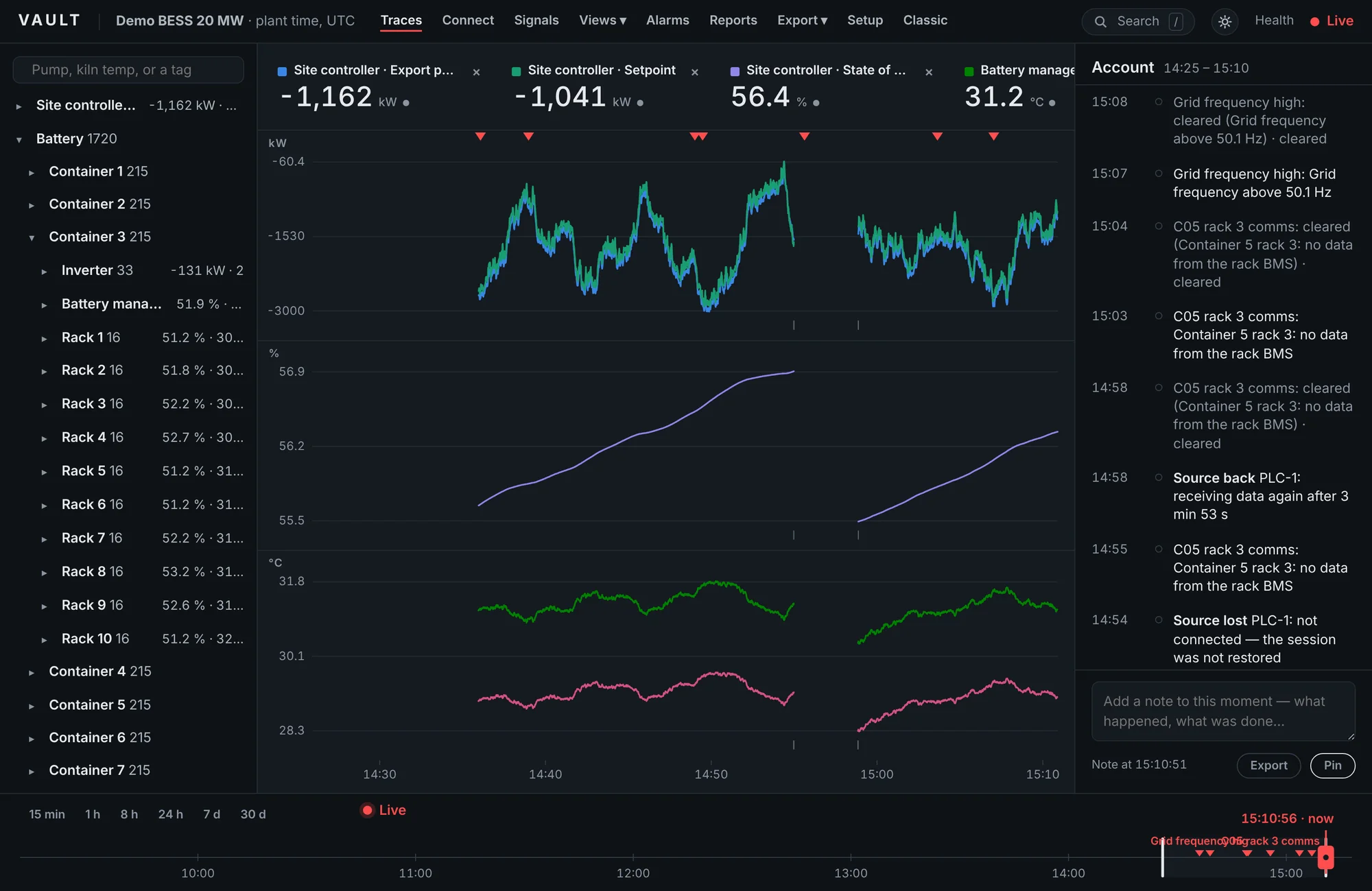
- The plantAreas, containers and equipment with their live values. Click one and its signals fill the strip.
- The stripEach unit gets its own lane. Quality is drawn into the line, and a missing stretch stays missing.
- The accountAlarms, source outages and people's notes, in time order and plain words.
- The railDrag the playhead back to a trip and the whole screen follows. Live is just the right-hand end.
Most small sites have no history worth trusting
Battery and generation sites run on data, then lose it at the moment it matters: the dispatch dispute, the trip investigation, the warranty claim. These are the usual places it lives today.
A CSV on the HMI
Fills the disk, rolls over, and nobody can say what the gaps are.
Lost after the first monthA database someone built
InfluxDB and Grafana on a spare box. It worked until the person who built it moved on.
Nobody owns itThe enterprise historian
Excellent, priced per tag, and quoted for the portfolio. A 20 MW site waits for the purchase order.
Too big for one siteThe supplier's portal
The battery or inverter supplier's cloud keeps what it chooses, at the resolution it chooses, for as long as the contract runs.
Not your recordBuilt to be left alone for years
Vault is designed for a panel PC in a container at the edge of a field, with nobody watching it. It starts with Windows, restarts itself and tells you plainly when something is wrong.
One program, no database
A 5.5 MB setup installs a Windows service. SQLite and everything else is built in, so there is no database to license, run or back up separately.
Acknowledged means kept
Every value reaches a write-ahead log on disk before it counts. After a crash or restart Vault replays the log and marks the moment it stopped.
Gaps shown as gaps
Outages, restarts and full disks are written into the record. Trends break where data is missing and exports say so. Nothing is drawn across.
Sealed, checked files
Each day's file is sealed with a SHA-256 hash and every chunk carries a CRC. Damage is found and contained to one file, never trusted.
Guided PLC connection
Discover the server, trust certificates both ways, tick the signals. Step-by-step guides for Siemens S7-1500 and Phoenix Contact PLCnext.
The plant, not a tag list
Signals sit under areas and equipment with plain names. Play back a trip, compare with yesterday, pin a note to the moment it happened.
More in the product tour and the full specifications.
Tested like a plant, not a demo
Reliability claims are cheap. These are the tests Vault has been through so far, written up the way a factory acceptance test is: what was done, what came out, and under what conditions. The one still open says so.
| Ref | Test | Result | Verdict |
|---|---|---|---|
| T-01 | Hard kill under load400 crash-test runs against the real program, including 339 hard kills while collecting, starting and shutting down and 56 clean stops, each followed by a full check of every stored value | 0 acknowledged values lostWorst loss at a kill: 39 ms at a 20 ms log sync on an idle rig; 71 ms with another process loading the CPU. Linux test rig; process kills, not power cuts. | PASS |
| T-02 | Worst-nightmare fault injectionA test server sending known values through a proxy that drops, stalls and corrupts traffic; full disks, bit rot, 140 kills, hostile queries | 0 wrong, 0 duplicated, 0 gaps unmarked2,942,223 values compared with what was sent. 26 defects found and fixed along the way. | PASS |
| T-03 | Windows soak2,500 signals from a simulated battery site over OPC UA (security None), one Windows service | 6.9 days without a restart632 M samples collected in that run (1,058 a second on average). All 675 M samples in the eight day files decoded and checked against their hashes: 0 errors. Seven 30-second stalls caused by an OPC UA library fault were stored as marked gaps (99.96 % captured). The fix is verified in a proxy test; a soak re-run on the fixed build is still to do. | PASS |
| T-04 | Load3,000 tags at one second, no deadband, release build | 0.5–0.65 % of one CPU core2.8 GHz Xeon core. About 0.6 GB a day of raw one-second data. | PASS |
| T-05 | Year-long queryOne tag, a year of one-second data (31.5 million samples), read at one-day intervals | 0.09 sChunk summaries answer most of the query without decoding. | PASS |
| T-06 | Real PLCsA real Siemens S7-1500 and a Phoenix Contact PLCnext, over OPC UA with Sign & Encrypt, on an evaluation tester's bench | In progressResults will be published here, dated, as they come in. | OPEN |
| T-07 | Power cut on WindowsThe plug pulled on a Windows panel PC under load, five times, each followed by a full check | Not yet runProves the disk honours the log sync, which a process kill cannot. | OPEN |
| T-08 | 30-day soak3,000 signals at one second on the target panel PC, tracking memory, handles and disk | Not yet run | OPEN |
From download to logging in four steps
The first run is a short wizard. It asks where to keep the records, connects to the PLC, lets you tick the signals and starts logging. No project file, no database, no consultant.
- Records
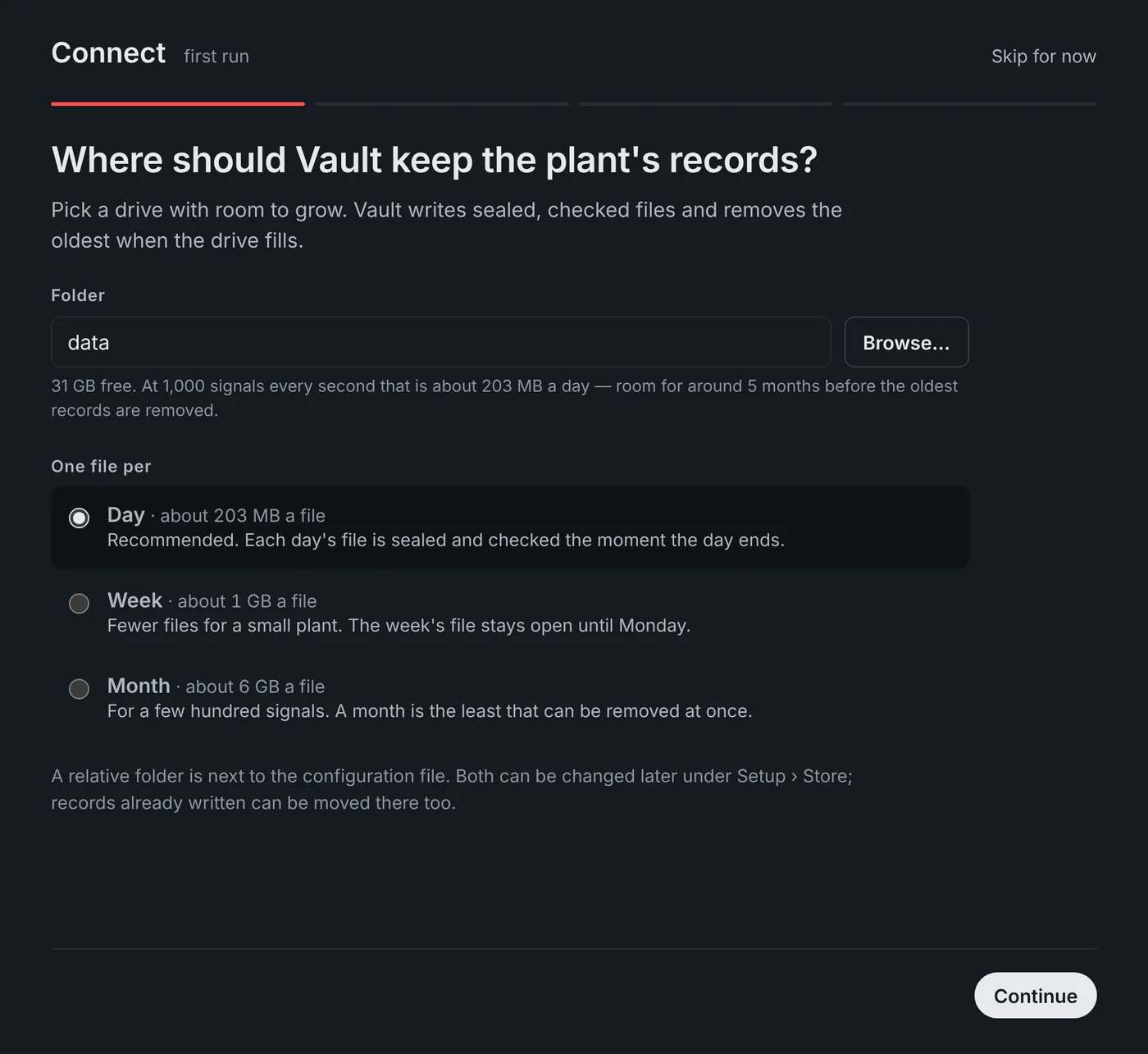
Pick a folder. Vault works out how many years the disk will hold at your signal count.
- Source
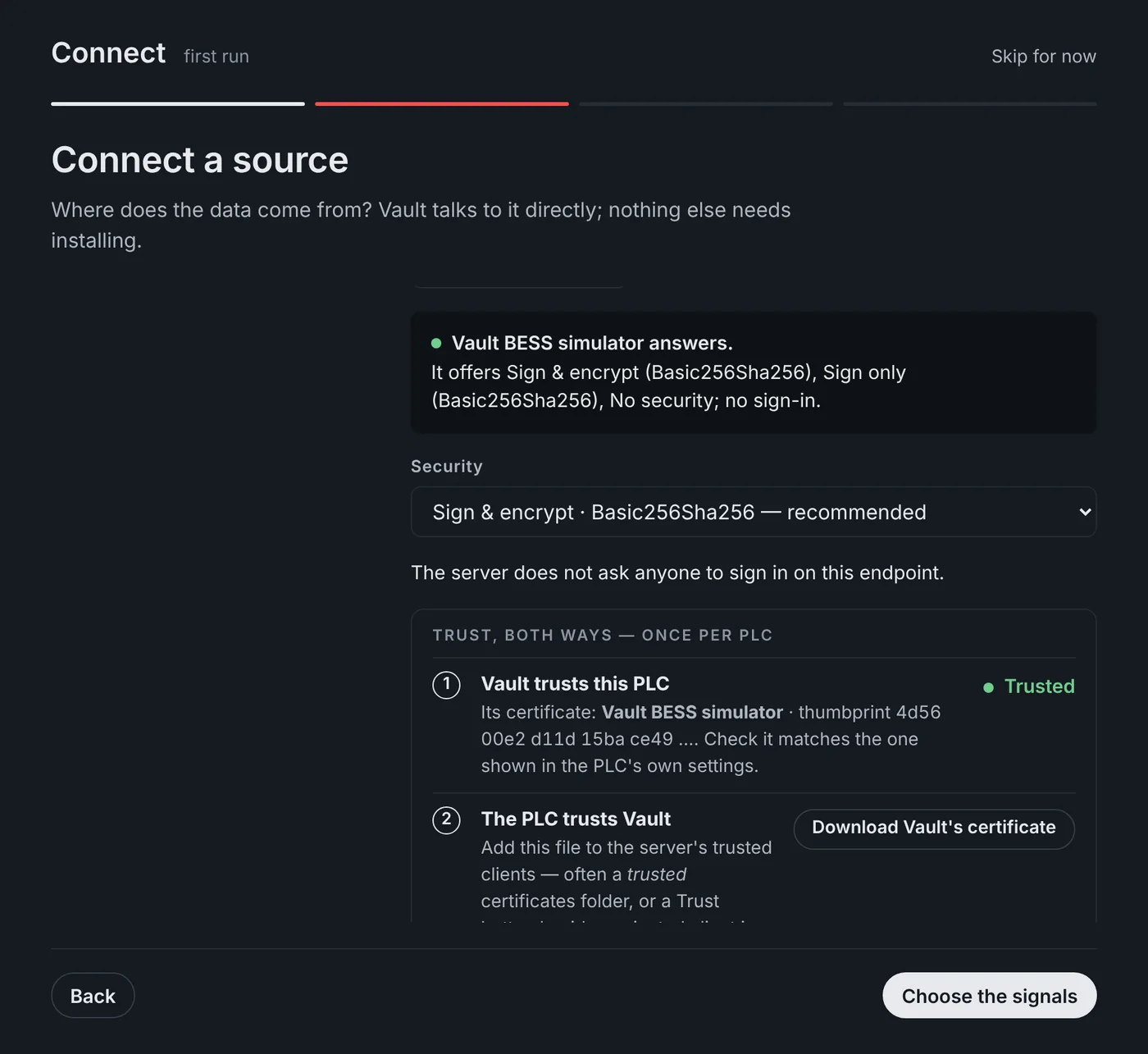
OPC UA or Modbus TCP. Discover asks the PLC what security it offers and picks the strongest.
- Signals
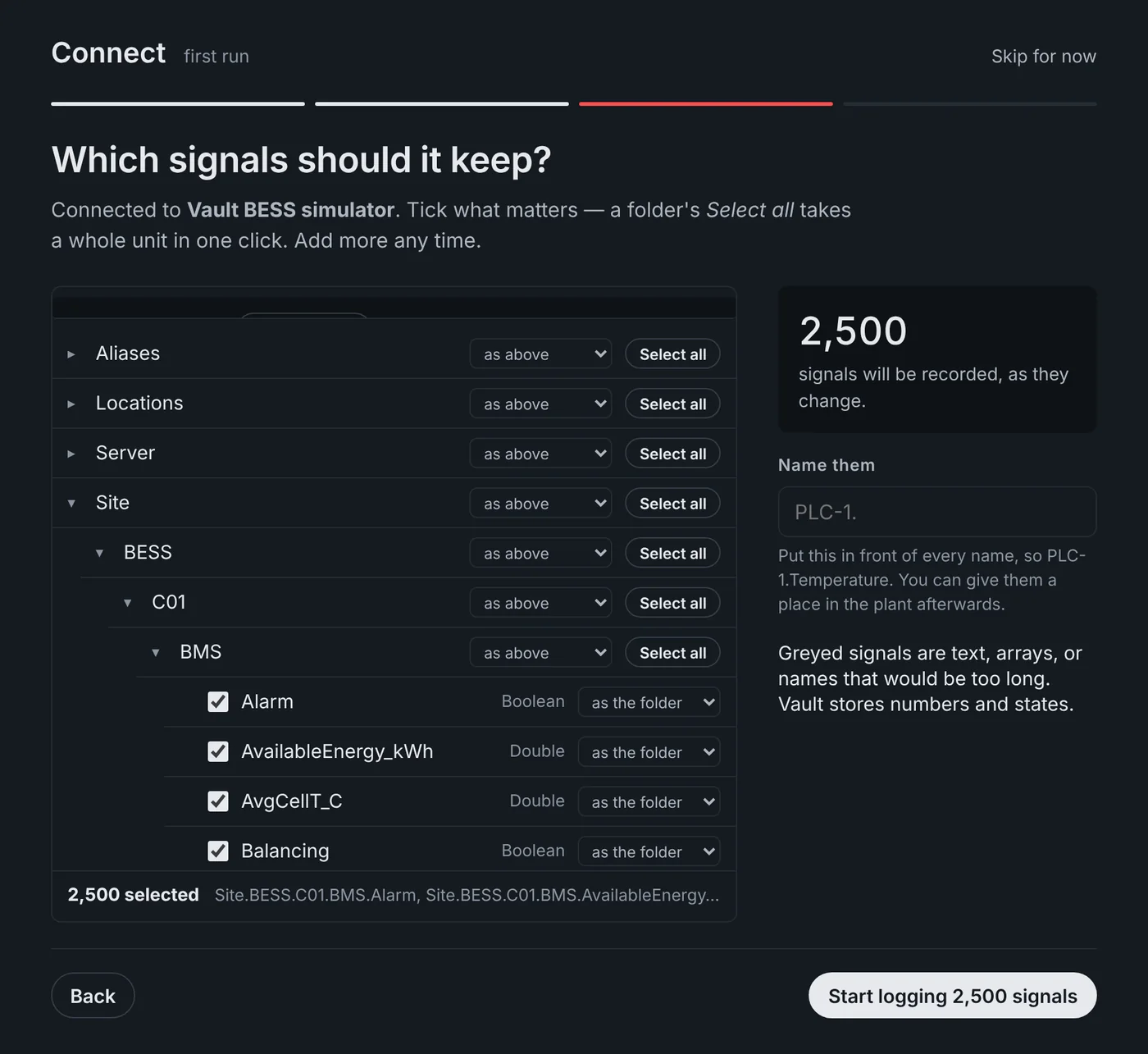
Browse the server's folders and tick what to keep. Select all is fine; there is no tag limit.
- Logging
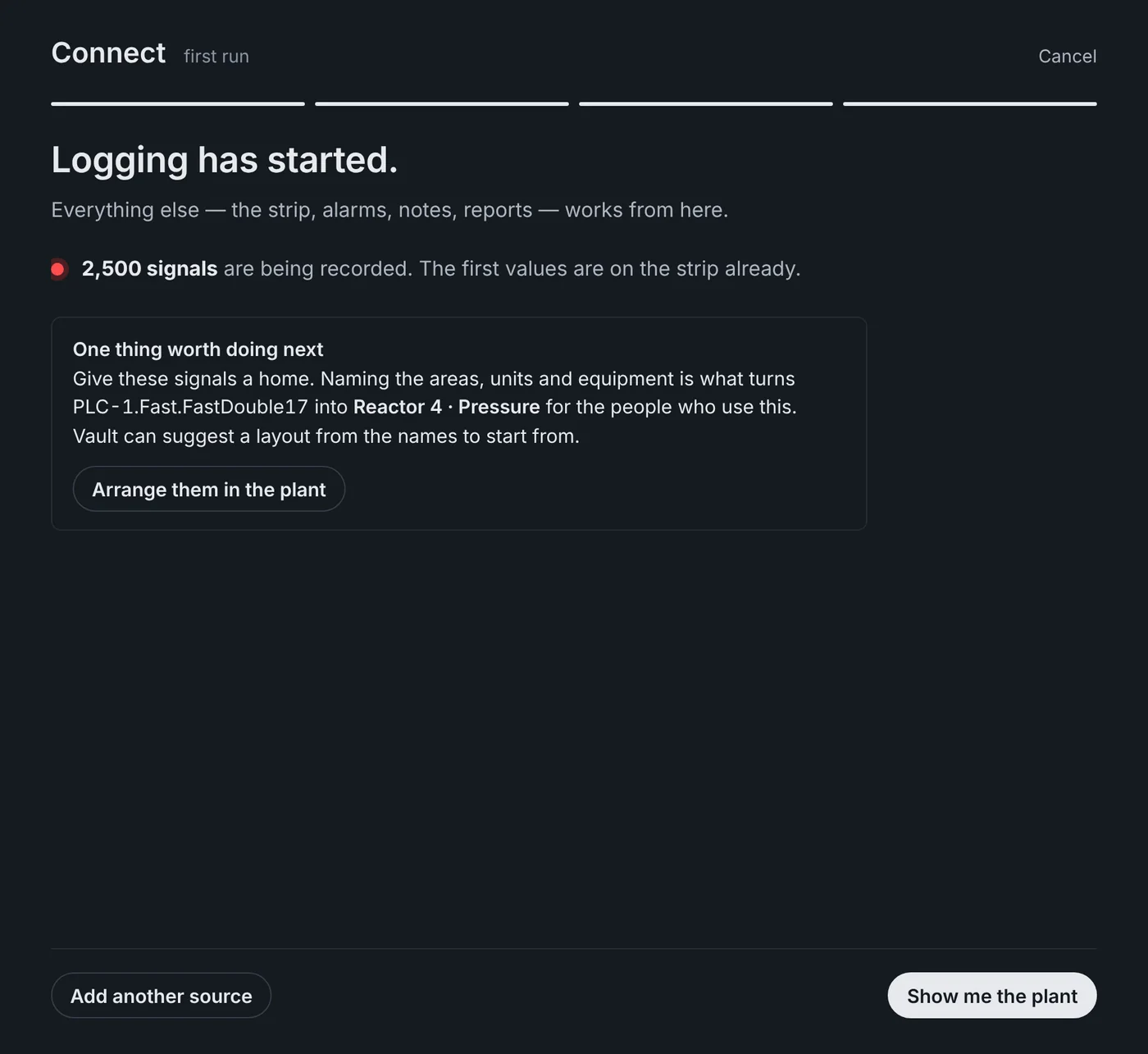
Logging starts at once. Name the equipment later so operators see Inverter 3, not a node ID.
Where Vault fits
Vault sits where an enterprise historian is too heavy and a CSV file is too fragile: one site, one PC, one engineer who needs the data this month.
Battery storage
PCS, BMS, racks, the point-of-connection meter, switchgear, HVAC and fire. Thousands of signals, kept at one second, with a record of every dispatch.
Vault for battery storageGeneration and grid connection
Peaking plant, CHP, solar and hybrid sites. The record you need when a trip, a grid-code test or a curtailment is questioned.
Logging over OPC UACommissioning and test benches
Log the FAT, the SAT and the first months of operation. Hand over the data with the site, in files anyone can open.
Logging over Modbus TCPOne licence per site, however many signals it logs and however many people look at it. The first year of updates and support is included. Vault keeps logging if you stop paying for updates.
Articles for the people who run the plant
Practical writing on site data: what to log, how to size it, and what to check before you trust a trend.
What is an industrial data historian?
What a historian does, how it differs from SCADA trends and a general database, and the questions worth asking before you choose one.
Why your trend draws a line across the outage
Many trends join the line across a lost connection, and the chart looks fine. Why it happens, why it matters, and a ten-minute test for your own system.
How much disk does a historian need on a battery site?
A worked method for sizing storage, with measured figures from a week of logging 2,500 signals from a simulated 20 MW battery site.
See Vault on your own plant
Early access sites get the full product, direct help from engineering, and their first site licence for £1,995 instead of £2,495.